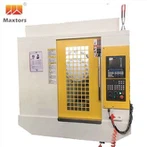
The difference between a milling machine and a planer.
Milling machine: A machine tool that mills a workpiece with a milling cutter. In addition to milling planes, slots, gear teeth, threads and spline shafts, milling machines can also process more complex profiles, with higher efficiency than planers, and are widely used in machinery manufacturing and maintenance departments. Planer: A linear motion machine that uses a planer to plan flats, grooves, or formed surfaces of a workpiece. With planer processing, the tool is simpler, but the productivity is low (except for processing long and narrow planers), so it is mainly used for single-piece, small batch production and machine repair workshops, in mass production. According to the structure and performance, the planer is mainly divided into bullhead planer, gantry planer,
The planer is named after the ram, and the knife holder is shaped like a bull's head. The planer is installed on the tool holder of the ram for longitudinal reciprocating motion, and is mostly used for cutting various planes and grooves. The gantry planer is named after the gantry frame structure composed of top beams and columns. The worktable carries the workpiece for linear reciprocating motion through the gantry, which is mostly used for processing large planes (especially long and narrow planes). The grooves or planes of multiple small and medium-sized parts can be machined at the same time. Large gantry planers are often equipped with milling heads, grinding heads and other components, so that the workpiece can be planed, milled and ground at one time. The single-arm planer has a single column and a cantilever, and the worktable reciprocates longitudinally along the bed guide rail. It is mostly used for workpieces with large widths that do not need to be machined over the entire width.
The reciprocating linear motion is performed by the tool or the workpiece, and the intermittent feed motion is performed by the workpiece and the tool perpendicular to the main motion. Commonly used planers are: head planer, gantry planer and single-arm planer.
Difference between boring machine and milling machine
The working principle and performance of boring and milling machines are similar. The rotation of the tool is the main movement, and the movement of the workpiece is the feed movement.
Boring machines are mostly used to process long through holes, large diameter stepped holes, and holes in different positions of large box parts. Due to the high rigidity of the cutter head and boring bar of the boring machine, the straightness, cylindricity and position of the machined hole are all high.
Milling machines can also perform boring, but the machining range is smaller and the accuracy is lower. Milling machines are mostly used for machining planes, forming surfaces, grooves, etc.
The radial arm drill is an efficient hole-making machine because its spindle can move quickly and arbitrarily within the machining range, while the workpiece is fixed. Therefore, it is very effective to machine holes and screw holes in different positions on large box parts.